Shimmy Shield — The Future of Automated Content Moderation
A Foundational Research Brief for Shimmy's 3/5/8/12-Year Strategic Horizon
Prepared for: Shimmy Executive & Product Strategy Scope: ML/NLP/CV architecture evolution, sociopolitical dynamics of digital spaces, and infrastructure economics governing trust & safety systems through 2038 Framing note: Shimmy's positioning as a "calmer, anti-doomscroll" network with contextual feeds and built-in moderation gives it a structural advantage over incumbents in Horizons 1–2 (moderation is a first-class product feature, not a bolted-on cost centre) but also raises the stakes for Horizons 3–4, where trust infrastructure is the product.
Executive Horizon Matrix
| Horizon | Core ML Architecture | Primary Moderation Challenge | Infrastructure Bottleneck |
|---|---|---|---|
| 1–3 yr (Near) | Multimodal LLMs & VLMs, mixture-of-experts routing | Sarcasm, regional slang/code-switching, real-time video/audio latency | Inference cost ($/token, $/frame) at scale |
| 4–5 yr (Mid) | Edge-AI, federated learning, graph neural nets for coordination detection | Privacy-preserving cross-device signal, cross-platform coordinated inauthentic behaviour (CIB) | On-device compute/thermal constraints, federated aggregation bandwidth |
| 6–8 yr (Long) | Cryptographic provenance (C2PA-class), zero-knowledge attestation, synthetic-content classifiers | Hyper-realistic deepfakes, synthetic spam swarms, protocol-level (AT Proto/Nostr) content with no central chokepoint | Content authenticity tracking across federated/decentralized graphs |
| 9–12 yr (Vision) | Agent-native semantic consensus protocols, cognitive defence layers | Agent-to-agent negotiation on behalf of humans, algorithmically-induced echo chambers between AI agents themselves | Bandwidth/latency of real-time decentralized semantic consensus |
V1 Implementation — Current Architecture (As Built, Text Moderation)
This section documents Shimmy Shield's actual current build, not a recommendation — it sits ahead of the forward-looking Horizon 1–4 analysis below because it's the ground truth those horizons build from. Where this section shows the system already doing something Horizon 1 recommends (conditional Gemma 3 invocation, tiered routing), that's a sign V1 is ahead of where a from-scratch build would be, not a reason to skip the horizon analysis — it still governs where V2+ goes next.
Create Post/Shimmy: the entry flow
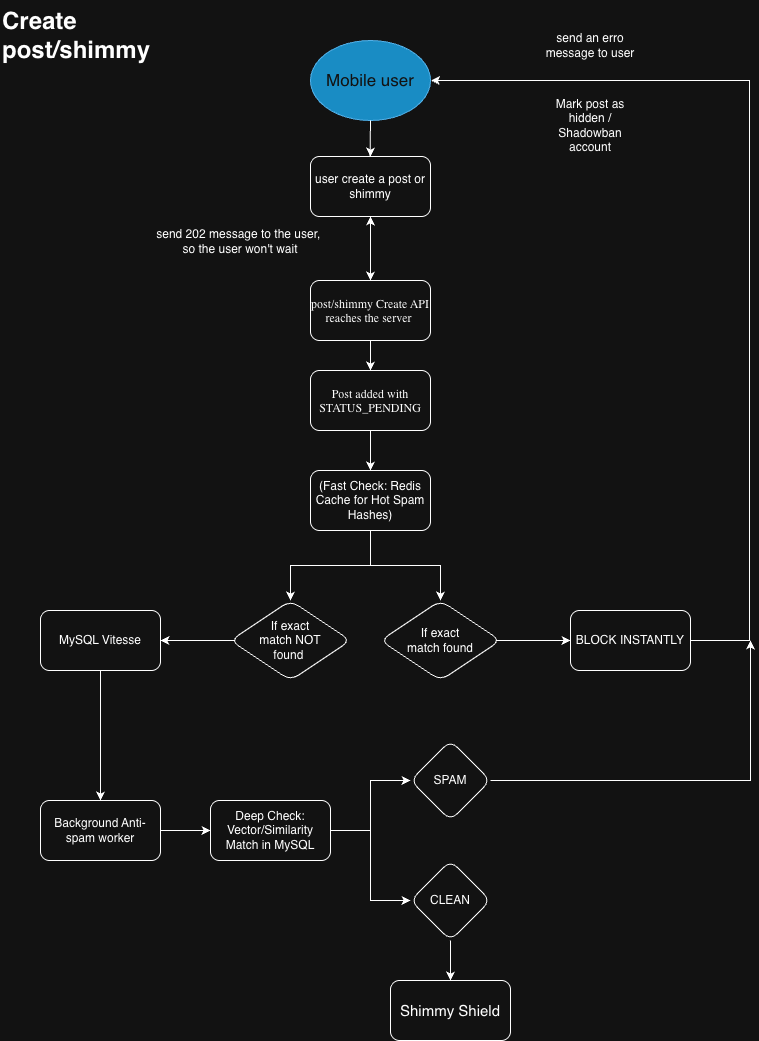
Every post or Shimmy creation follows the same entry path before anything is visible publicly:
- A mobile user creates a post or Shimmy from the client.
- The post/Shimmy Create API call reaches the server, which immediately returns a
202response to the user — the user's client doesn't wait on moderation to complete before the UI unblocks. - The post is written with
STATUS_PENDING. Posts in this state are never added to feeds — this is the same shadow-buffering principle used later in the Grey Zone escalation (Layer 2, below), applied from the very first millisecond of a post's life. - A fast Redis-backed hash check runs against known spam/abuse hashes (Two-Tiered Hash Defence, below) before the post enters the main triage pipeline.
Two-Tiered Hash Defence
Before a post reaches any ML model, it passes through two progressively more expensive hash-based checks — cheapest, highest-confidence signal first.
Tier 1 — The Exact-Match Firewall. Standard SHA-256 or MD5 hashing of binary files (attachments, known spam images, malware scripts) and raw text. On submission, the post is hashed instantly and checked against a blacklisted_hashes set in Redis. An exact match is blocked instantly — no further AI inference is spent on content Shimmy has already positively identified as violating.
Tier 2 — The Similarity Filter. Exact hashing fails the moment content is even slightly altered, which is why a second, smarter layer exists for near-duplicate text and images: Locality-Sensitive Hashing (LSH) or vector embeddings, converting content into a numerical representation of its meaning rather than its literal bytes. Shimmy Shield uses MySQL's native VECTOR data type and DISTANCE() function (available since MySQL 9) to store and query spam embeddings directly in the primary database, rather than standing up a dedicated vector store for this tier. The known catch, flagged honestly rather than glossed over: native in-database vector distance calculation can get computationally heavy under traffic spikes — this is a specific, named scaling risk for Shield's hash-defence layer, distinct from the inference-cost scaling already discussed in Infrastructure, Part 3.5.
The Triage Strategy: Short-Circuiting the Vote
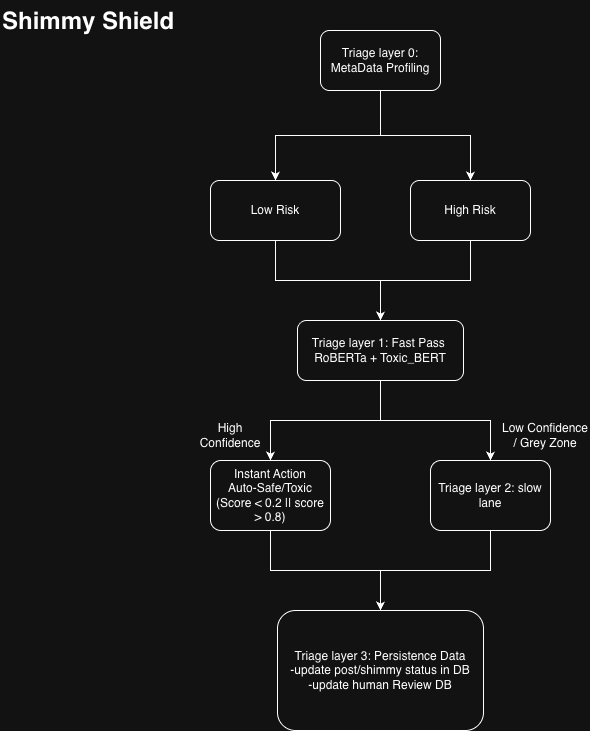
Content that clears the hash defence enters a four-layer triage pipeline designed to spend expensive model inference only where it's actually needed.
Layer 0 — Metadata Profiling (the pre-filter)
Before a single AI model is touched, the API Gateway evaluates the metadata of the user and the destination Shimmy to assign a Risk Vector:
- Low Risk — an aged account with a clean trust record, posting in a private or low-traffic Shimmy.
- High Risk — a new account (under 24 hours old), any history of flags, or posting in a globally trending/public Shimmy.
Low-risk posts are greenlit for the Fast Lane (Layer 1); high-risk posts bypass certain optimisation cutoffs to ensure they always receive full scrutiny, regardless of what the fast-pass models conclude.
Account age is tiered, not binary:
| Phase | Age | What it means |
|---|---|---|
| "Sandbox" | 0–7 days | Highest-risk window — roughly 90% of automated spam bots reveal themselves within this period. Public-Shimmy posts from Sandbox-phase accounts route straight to the slow lane. |
| "Established" | 30 days | The standard baseline for treating an account as sufficiently aged to remove basic training-wheel scrutiny — a spammer's account is usually caught or reported within its first month if it's going to be. |
| "Veteran" | 6 months – 1 year | True aged status. Accounts that survive this long with a clean record are highly trusted by the algorithm. |
The trusted-aged-user determination is a simple, explicit rule rather than a learned model — worth keeping simple deliberately, since this gate feeds directly into how much scrutiny everything downstream receives:
if (accountAge >= 30_DAYS && totalLoginDays >= 7 && successfulInteractions >= 15) {
    setIsAgedUser(true);
}
Layer 1 — The Fast Lane (encoder consensus)
The post is processed concurrently by Toxic-BERT and RoBERTa, both returning a result in under 50ms.
- Scenario A — Unanimous absolute clear (score < 0.20): bypass all further AI. Status immediately becomes
APPROVEDand the post goes live. - Scenario B — Unanimous absolute violation (score > 0.80): flag as hidden instantly, write the offence to the user's account profile in MySQL, and skip Gemma 3 entirely — an unambiguous violation doesn't need an expensive reasoning model to confirm what two fast classifiers already agree on, which is precisely the cost discipline Infrastructure, Part 3.1 recommends generalising into V2+.
Layer 2 — The Slow Lane / Grey Zone escalation (score 0.20–0.80)
When Toxic-BERT and RoBERTa disagree, or the score falls in the ambiguous middle band, the post escalates rather than forcing a premature decision:
- State isolation — the post is written to MySQL with
mod_status = 'pending_review'and is visible only to its author, so the posting experience doesn't feel interrupted even though the post isn't public yet (the same shadow-buffering principle from the entry flow, applied again here). - Context enrichment — the triage system pulls the parent Shimmy's title, category, and the user's risk profile from PostgreSQL and appends this context to the post text before escalating it.
- Gemma 3 evaluation — the enriched context block is sent to Gemma 3, which uses the parent Shimmy's theme to judge whether the text is genuinely toxic or contextually acceptable (an aggressive-sounding phrase in a competitive-gaming Shimmy reads very differently in a bereavement-support Shimmy) — this is the concrete mechanism behind the "community-local norm embeddings" concept referenced throughout this brief's Horizon 1 discussion below, not a separate idea.
Layer 3 — The Persistence Layer (database split)
Once a verdict is reached, the result is synced across Shimmy's polyglot database layer:
- MySQL (the post/feed engine) — updates the post's status. A Gemma-3-cleared post moves to
approvedand becomes instantly discoverable in the public feed; a rejected post moves tohidden. - MySQL (the system core) — if a post was hidden, an entry is created in
moderation_reports. If the user has crossed a violation threshold, their account status is automatically updated tosuspendedorflaggedin the users table, without requiring a human to action the escalation manually.
Architectural benefits of this design
- Cost efficiency — expensive Gemma 3 inference is spent only on the roughly 10–15% of posts that land in the Grey Zone or come from high-risk accounts, not on every post. This is the same tiering discipline Infrastructure, Part 3.1 recommends generalising, already proven out in Shield's actual V1 build.
- Resilience to traffic spikes — if a Shimmy goes viral, Layer 1 absorbs the mass influx of content instantly; if the Gemma 3 queue backs up, shadow-buffering means users never see a stalled posting experience while their content waits in the slow lane.
- Contextual accuracy — by blending the parent Shimmy's own context directly into the triage payload, Shimmy Shield behaves less like a generic content sensor and more like a moderator who understands where in the platform a conversation is actually happening.
Production tweaks — the confidence thresholding matrix
Not every violation category should be held to the same bar. Shimmy Shield applies category-specific auto-action thresholds rather than one global severity cutoff:
| Violation category | Auto-hide threshold | Auto-approve threshold | Action for the middle zone |
|---|---|---|---|
| Severe toxicity / threats | ≥ 0.75 | < 0.30 | Lock & hide instantly, route to human review |
| Spam / promotional | ≥ 0.85 | < 0.40 | Keep live but demote in public-Shimmy discover feeds |
| Profanity / slang | ≥ 0.90 | < 0.50 | Approve, but flag for the Shimmy creator's own content filters |
Severe categories are held to a tighter, more cautious band (a wider "must escalate" middle zone) than lower-stakes categories like profanity, where the creator's own community settings are the more appropriate control than a platform-wide auto-hide.
Production tweaks — per-category telemetry
Rather than logging a single aggregate pass/fail ratio, Shield pipes telemetry asynchronously into a time-series store (Prometheus-class, or an OpenSearch dashboard) tracking three specific signals:
- Model divergence rate — how often Gemma 3's Layer 2 verdict reverses the initial Toxic-BERT/RoBERTa assessment, which is the single best available signal for whether the fast-lane models need retraining or threshold adjustment.
- False-positive ratio per Shimmy category — whether specific Shimmy types (Gaming vs. News, for instance) see elevated false-positive rates, which is exactly the kind of per-community calibration need this brief's Horizon 1 section (below) argues for on first-principles grounds — V1 is already instrumented to detect it empirically.
- Pipeline latency per phase — Layer 1 vs. Layer 2 vs. Layer 3 processing time, broken out so a latency regression can be traced to a specific phase rather than triaged as a vague "moderation feels slow" report.
Horizon 1 (Years 1–3): From Regex to Real-Time Multimodal Reasoning
1.1 The architectural transition
The dominant paradigm shift is from classification-first pipelines (a keyword/regex layer feeding a binary or multi-class toxicity classifier, e.g., Perspective-API-style scoring) to reasoning-first pipelines, where a multimodal LLM/VLM ingests text, image, and short-form video jointly and produces a policy-grounded judgement with rationale, not just a score. This matters strategically because rationale generation is what makes moderation decisions appealable, auditable, and trainable — three properties regulators and users increasingly demand simultaneously.
Practically, this means Shimmy's moderation stack should be architected around three tiers rather than one model:
- Tier 0 (cheap, high-recall filter): small distilled classifier (\< 1B params) or even non-ML heuristics doing a first pass at near-zero cost, screening the ~95% of content that is unambiguously benign.
- Tier 1 (contextual VLM): a mid-sized multimodal model (think current-generation 8B–30B class, quantized/distilled) evaluating flagged content with context — thread history, poster reputation, community norms of the specific group/feed.
- Tier 2 (escalation reasoning model): a larger frontier-class model reserved for edge cases, appeals, and novel adversarial patterns, invoked at low volume but high stakes (legal exposure, self-harm, coordinated harassment).
This tiering is the single highest-leverage cost lever available in this horizon — routing correctly can cut blended inference cost by 80–95% relative to running a frontier model on all content.
This is already substantially true of Shimmy Shield V1 — see V1 Implementation, above. Layer 0's metadata Risk Vector plays the role of Tier 0, Layer 1's RoBERTa/Toxic-BERT fast pass plays Tier 1, and Layer 2's conditional Gemma 3 escalation plays Tier 2 — invoked only on the 10–15% Grey Zone, not on every post. What V1 doesn't yet do is the multimodal half of this section (image/video moderation is still text-only in V1, per Infrastructure, Part 3.4) — that remains genuine Horizon 1 forward work, not something already shipped.
1.2 Context-awareness and the sarcasm/nuance problem
Sarcasm, irony, and reclaimed slurs remain the hardest unsolved subclass of moderation error because they require theory-of-mind-adjacent inference: what does the speaker believe the listener believes? Three concrete mitigations differentiate leaders from laggards here:
- Thread-conditioned inference — feeding the model the preceding N messages and the poster's relationship to the community (new member vs. long-tenured), not just the flagged utterance in isolation. Context window cost scales linearly, but false-positive reduction is often the single largest driver of user trust and retention.
- Community-local norm embeddings — rather than one global policy, maintain a learned representation of acceptable register per community/feed (a private meme group vs. a public fundraising thread on Shimmy has categorically different baselines), and condition the Tier 1 model on it.
- Calibrated abstention — the model should be explicitly trained/prompted to output "insufficient confidence, escalate to Tier 2 / human review" rather than forcing a binary decision. Uncalibrated forced-choice classifiers are the leading cause of both false-positive user backlash and false-negative harm at this horizon.
1.3 Real-time video/audio latency
Live and short-form video moderation is constrained by frame-sampling economics: running a VLM on every frame is infeasible at scale, so the practical approach is adaptive frame sampling — sample sparsely by default, and dynamically increase sampling density when audio transcription (via a lightweight streaming ASR model) or motion/scene-change detection signals elevated risk. Audio-channel moderation (via streaming Whisper-class ASR feeding the text pipeline) is frequently cheaper and higher-signal than dense visual sampling for most harm categories except CSAM/graphic violence, which require frame-level CV regardless of cost.
1.4 Infrastructure economics: the compute-vs-latency tradeoff
The central bottleneck of this horizon is $/token at acceptable p99 latency. Three concrete strategic levers:
- Batching vs. real-time tension: asynchronous post-publish review can batch aggressively and use cheaper spot/batch inference pricing; pre-publish (pre-send) moderation cannot, and must run on always-on provisioned capacity, which is 3–5x more expensive per unit inference. Shimmy's product philosophy (contextual, non-doomscroll feeds) may actually permit more async, post-publish-with-soft-quarantine moderation than a real-time feed product, which is a genuine cost advantage worth building into the roadmap explicitly.
- Model distillation cadence: frontier labs release new base models roughly every 6–9 months; the winning operational pattern is a standing pipeline that re-distills a frontier "teacher" model into a smaller in-house "student" classifier every cycle, rather than re-architecting from scratch. This should be a funded, recurring line item, not a one-off project.
- Vendor vs. self-hosted inference: at Shimmy's likely scale through year 3, API-based inference (Anthropic/OpenAI/etc.) will almost certainly beat self-hosted GPU infrastructure on total cost of ownership once engineering/ops overhead is accounted for — the crossover point to self-hosting typically only favours self-hosting above roughly hundreds of millions of moderation calls/month, and only for the Tier 0/1 layers.
Bottom line for Horizon 1: the strategic asset to build is not "a moderation model" but the tiered routing and context-injection infrastructure around off-the-shelf models — this is what's defensible and what compounds.
Horizon 2 (Years 4–5): Predictive, Federated, and Coordination-Aware Systems
2.1 From reactive to predictive moderation
The paradigm shift here is from scoring individual pieces of content to modelling networks and trajectories. The key technical enabler is graph neural networks (GNNs) applied to the interaction graph (who replies to whom, timing patterns, account creation clustering, content-similarity clustering across accounts) to detect coordinated inauthentic behaviour (CIB) before any single piece of content trips a content-level filter. A single hostile post is often policy-compliant in isolation; the same post posted by 400 accounts within 90 seconds is a network-level signal invisible to any per-item classifier.
Concretely, this requires:
- A near-real-time graph store capable of streaming updates to the interaction graph (not a nightly batch job).
- Anomaly detection on temporal and structural graph features (burstiness, account-age distribution of a cascade, cross-account text/image near-duplication) rather than content semantics alone.
- Virality-curve interception: modelling the predicted diffusion curve of a piece of content (using early engagement velocity as a leading indicator) to intervene during the exponential-growth phase rather than after peak reach — this is the technical core of "predictive" moderation and is where the actual harm-reduction leverage lives, since most real-world harm from misinformation/harassment cascades occurs in the first few hours of virality.
2.2 Federated learning and on-device moderation
Regulatory and user trust pressure (post-GDPR-successor regimes, on-device processing expectations set by mobile OS vendors) pushes first-pass moderation onto the device itself. The realistic architecture is:
- A small on-device model (distilled, quantized to run in the low hundreds of MB, feasible on-device even on mid-range hardware) performs local pre-screening before content ever leaves the device — catching the most severe categories (CSAM, extreme violence) locally and instantly, and flagging borderline content for server-side Tier 1/2 review.
- Federated learning aggregates model weight updates, not raw user data, from on-device usage back to a central model, using secure aggregation protocols so no individual user's data is ever visible in the aggregate. This is technically mature (used in production by major mobile keyboard/predictive-text systems already) but remains non-trivial for moderation specifically because label quality on-device is inherently noisier — most practical implementations combine federated learning with a smaller, centrally-labelled "gold set" to prevent model drift toward device-population biases.
- Cross-platform coordination detection becomes the hard unsolved problem at this horizon: coordinated campaigns increasingly originate or coordinate off-platform (via encrypted messaging apps, other social platforms) and only manifest on a given platform as a burst. This pushes toward industry-shared threat-intelligence signals (hash-sharing consortia, similar to existing CSAM hash-sharing infrastructure like PhotoDNA, but generalized to coordination fingerprints) — a strategic partnership decision, not purely a technical one, and one Shimmy should evaluate joining or co-founding given its trust-first brand positioning.
2.3 Strategic implication for Shimmy
Federated/edge moderation is expensive to build in-house at Shimmy's likely scale in years 4–5. The higher-leverage move is a hybrid: adopt vendor/open infrastructure for the commoditized layer (on-device pre-screening SDKs, hash-sharing consortium membership) while investing proprietary engineering effort specifically in the graph-based coordination detection tuned to Shimmy's actual social graph shape (which, given the contextual-feed/community structure, likely differs meaningfully from open, follower-graph platforms).
Horizon 3 (Years 6–8): Decentralisation and the Synthetic Content Majority
3.1 Moderation without a chokepoint
Protocol-based social graphs (AT Protocol/Bluesky's model, Nostr's relay model) explicitly decentralise the moderation chokepoint: there is no single company positioned to unilaterally remove content from the network, only from the views it serves (feeds, relays, labelers). The architectural response is composable/portable moderation: instead of a single moderation verdict, the system publishes labels/attestations (via signed, portable label services, as AT Protocol's model does) that downstream clients and feed algorithms can choose to honour or ignore.
Strategically, this reframes the moderation product from "we decide what's allowed" to "we operate one of several trust layers a user or client can subscribe to" — which is a fundamentally different business model (a moderation-as-a-service labeler that other apps/clients can subscribe to) worth scenario-planning now, since it could become either a threat (disintermediation of Shimmy's current control) or a new product line (Shimmy's moderation stack, tuned for calm/anti-doomscroll norms, licensed to other decentralised clients).
3.2 The 80%-synthetic-content world
When the majority of content is AI-generated or AI-augmented, binary "is this AI-generated" detection becomes strategically useless — it will have near-universal positive hits and provides no actionable signal. The paradigm must shift from detecting synthetic content to verifying provenance and intent:
- Cryptographic provenance (C2PA-class content credentials): content is signed at the point of capture/generation with a tamper-evident manifest describing its creation history (camera, edits, generative tool used). The moderation question shifts from "was this made by AI" to "does this content's provenance chain match its claimed context" — e.g., a synthetic image is not inherently harmful, but a synthetic image presented as raw photographic evidence of a real event is a provenance-mismatch, which is the actual harm vector.
- Intent verification over content classification: the practical unit of moderation becomes the claim attached to content (this is real, this is satire, this is a paid endorsement) rather than the pixels/text themselves. This requires moderation systems to reason jointly over content and the structured/unstructured claims accompanying it — a natural extension of the context-conditioned reasoning built in Horizon 1, now applied to authenticity claims rather than toxicity.
- Synthetic spam swarms (AI agents generating high-volume, human-plausible engagement/content at near-zero marginal cost) make volume-based heuristics (post frequency, account age) increasingly useless, since synthetic actors can trivially mimic human temporal patterns. Defence shifts to behavioural-economic signals that remain expensive for an attacker to fake at scale even with generative AI: cross-session identity consistency, verified real-world attestations (proof-of-personhood systems), and economic staking mechanisms (cost-to-post models) rather than purely content-based detection.
3.3 Strategic implication for Shimmy
Given Shimmy's existing GoFundMe/fundraising integration, provenance and intent-verification infrastructure is not merely a defensive moderation investment — it's directly monetisable trust infrastructure for the fundraising use case specifically (verifying a fundraiser's claims/identity is a superset of the general provenance problem). This is a case where the Horizon 3 moderation investment and a core product line converge, and should be planned as one workstream rather than two.
Horizon 4 (Years 9–12): Agent-Mediated Interaction and Cognitive Defence
This horizon is necessarily speculative; the following is grounded extrapolation from current agentic-AI trajectories (tool-using agents, agent-to-agent protocols such as emerging standards for agent identity and negotiation) rather than confident prediction.
4.1 Redefining the moderation unit
When AI agents transact, negotiate, and communicate on behalf of human principals, "content moderation" as a discrete review-and-remove function becomes only one layer of a broader cognitive defence stack. The relevant question is no longer "should this post be visible" but "should this agent-to-agent interaction be permitted to influence my principal's information environment/decisions at all." This implies moderation infrastructure converges with:
- Agent identity and provenance verification (which agent, acting for whom, under what delegated authority) — a direct extension of Horizon 3's provenance work, now applied to actors rather than content.
- Real-time semantic consensus protocols: rather than a single platform unilaterally judging content, groups of agents (representing users, platforms, and possibly regulatory bodies) reach distributed consensus on classification/action in real time, analogous to how distributed systems reach consensus on transaction validity today, but applied to semantic/policy judgments. The bandwidth and latency cost of this is the defining infrastructure bottleneck of this horizon — semantic consensus at conversational latency across a decentralized agent network is a substantially harder distributed-systems problem than today's content-delivery-network-style caching.
- Cognitive echo chambers between agents: a genuinely novel risk class where agents, optimising for engagement or task-completion proxies on behalf of users, reinforce each other's outputs in agent-to-agent loops with no human in the loop to notice drift — this requires moderation systems to monitor agent behaviour patterns over time, not single interactions, and is closer to an alignment/interpretability problem than a classical trust-and-safety problem.
4.2 What "moderation" plausibly means at this horizon
Best current framing: a cognitive defence layer operating as a permissioning and provenance-verification substrate that agents must satisfy before their outputs are allowed to reach or influence a human principal's information diet — less "content police," more "authenticated, rate-limited, provenance-checked API surface between autonomous agents and human attention." Shimmy's specific opportunity, if this trajectory holds, is to be a human-attention-protective layer by design (consistent with its anti-doomscroll positioning), which is a differentiated, defensible position relative to engagement-maximising incumbents who are structurally disincentivised from building genuine cognitive defence.
Critical Research Vectors to Track (Cross-Horizon)
-
Cost-to-accuracy ratio migration. Track the crossover economics between centralized cloud inference, hybrid edge/cloud, and eventual on-device-first architectures. This should be a standing quarterly metric (blended $/moderation-decision, tracked by tier), not a one-time architecture decision — the crossover points will move as model efficiency improves faster than most roadmaps assume.
-
Regulatory alignment as embedded infrastructure, not compliance overhead. The EU Digital Services Act and its successors (and comparable emerging frameworks in the UK, given Shimmy's base, via Ofcom's Online Safety Act enforcement) increasingly require auditable decision logs and systemic risk assessments as a matter of law. Building compliance logging (rationale capture from the Tier 1/2 reasoning models described in Horizon 1) into the ML pipeline from day one is dramatically cheaper than retrofitting it, and doubles as the audit trail needed for appeals and for training data curation.
-
Adversarial ML and the perturbation arms race. Track the specific technique classes: adversarial visual perturbations (imperceptible-to-human pixel changes that flip classifier outputs), prompt-injection-style attacks against the moderation LLM itself (content crafted to manipulate the moderator model's own reasoning, not just evade a classifier), and steganographic encoding of prohibited content within otherwise-benign generative outputs. Red-teaming the moderation stack itself (not just the platform's user-facing surface) should be a standing, funded workstream starting in Horizon 1, since the moderation model is now an attack surface in its own right.
Indicator Dashboard (Quarterly)
To stay vigilant on the future of AI, social dynamics, and Shimmy's market position, maintain the following standing dashboard and review it quarterly at leadership level.
| Indicator | Why it matters | Threshold / trigger | Owner |
|---|---|---|---|
| Blended moderation cost per decision (Tier 0/1/2 split) | Tracks economic viability of Shield routing model | Trigger review if >15% QoQ increase without matching risk reduction | Infrastructure + Trust & Safety |
| Grey-zone escalation rate | Signals model confidence quality and ambiguity drift | Trigger retraining/calibration if rate drifts beyond agreed range for 2 consecutive quarters | Trust & Safety |
| Model divergence rate (fast lane vs. escalation verdict) | Measures quality of Tier 1 decisioning | Trigger threshold audit if divergence trend rises quarter-over-quarter | Trust & Safety + ML |
| False positive rate by Shimmy category | Protects user trust and community fit | Trigger category-specific policy revision when FP exceeds policy tolerance | Product + Trust & Safety |
| High-severity miss rate (post-publication reversals) | Core safety integrity measure | Trigger incident review immediately on breach of severity threshold | Trust & Safety |
| Synthetic-content share of total submissions | Tracks AI-generated content transition speed | Trigger provenance roadmap acceleration if synthetic share rises above planned horizon assumptions | Product + Infrastructure |
| Provenance mismatch rate | Measures authenticity risk in fundraising/social content | Trigger verification hardening when mismatch trend accelerates | Trust & Safety + Fundraising Product |
| Coordinated behaviour detection lead time | Measures ability to stop campaigns early | Trigger graph-model upgrade if lead time degrades quarter-over-quarter | Trust & Safety + Data |
| Trust score trend (user-reported safety confidence) | Links moderation performance to product trust | Trigger joint Product/Shield review on sustained decline | Product + Trust & Safety |
| Regulatory response SLA (appeals, rationale logs, audit export) | Ensures compliance readiness as regulation evolves | Trigger compliance programme escalation if any SLA misses occur | Legal + Trust & Safety |
| Market sentiment shift: doomscroll fatigue and social trust signals | Connects macro-social behaviour to Shimmy's positioning | Trigger messaging/positioning update if signal weakens materially | Strategy + Product Marketing |
| Emerging agentic-social adoption signal | Tracks speed of Horizon 4 arrival risk | Trigger horizon timing review when enterprise/consumer signal crosses target adoption bands | Strategy + Product |
This dashboard should be mirrored into Roadmap & Milestones, Risk Register, and Financials so strategy, risk, and spend remain synchronized.
Summary Strategic Recommendations
- Years 1–3: Invest in tiered routing infrastructure and context-injection, not a single "moderation model." Exploit Shimmy's non-real-time, contextual-feed product design to shift more moderation to cheaper async/batch inference than competitors with live feeds can.
- Years 4–5: Build proprietary graph-based coordination detection tuned to Shimmy's community/feed graph shape; buy/partner for commoditized on-device and hash-sharing infrastructure rather than building it in-house.
- Years 6–8: Converge the provenance/authenticity-verification workstream with the GoFundMe/fundraising trust product line — this is a rare case of moderation infrastructure being directly monetisable, not just a cost centre.
- Years 9–12: Position Shimmy's brand-native "protect human attention" philosophy as the differentiator in an agent-mediated web, where most incumbents are structurally misaligned to build genuine cognitive defence.
Cross-link Index
- Related decisions: Infrastructure, Pillar II, Pillar I
- Related metrics: Financials, Roadmap & Milestones
- Related risks: Risk Register