Compounding Growth & User Psychology
Why "compounding," specifically
Most social products grow additively: each pound of marketing spend buys a roughly fixed number of new users, and CAC stays flat or rises as easy audiences are exhausted. A compounding growth model is different — each new user makes the next user cheaper, stickier, or more likely to arrive organically. Shimmy has four structurally different compounding loops available, and the strategic priority is building the product so all four reinforce each other rather than competing for engineering time.
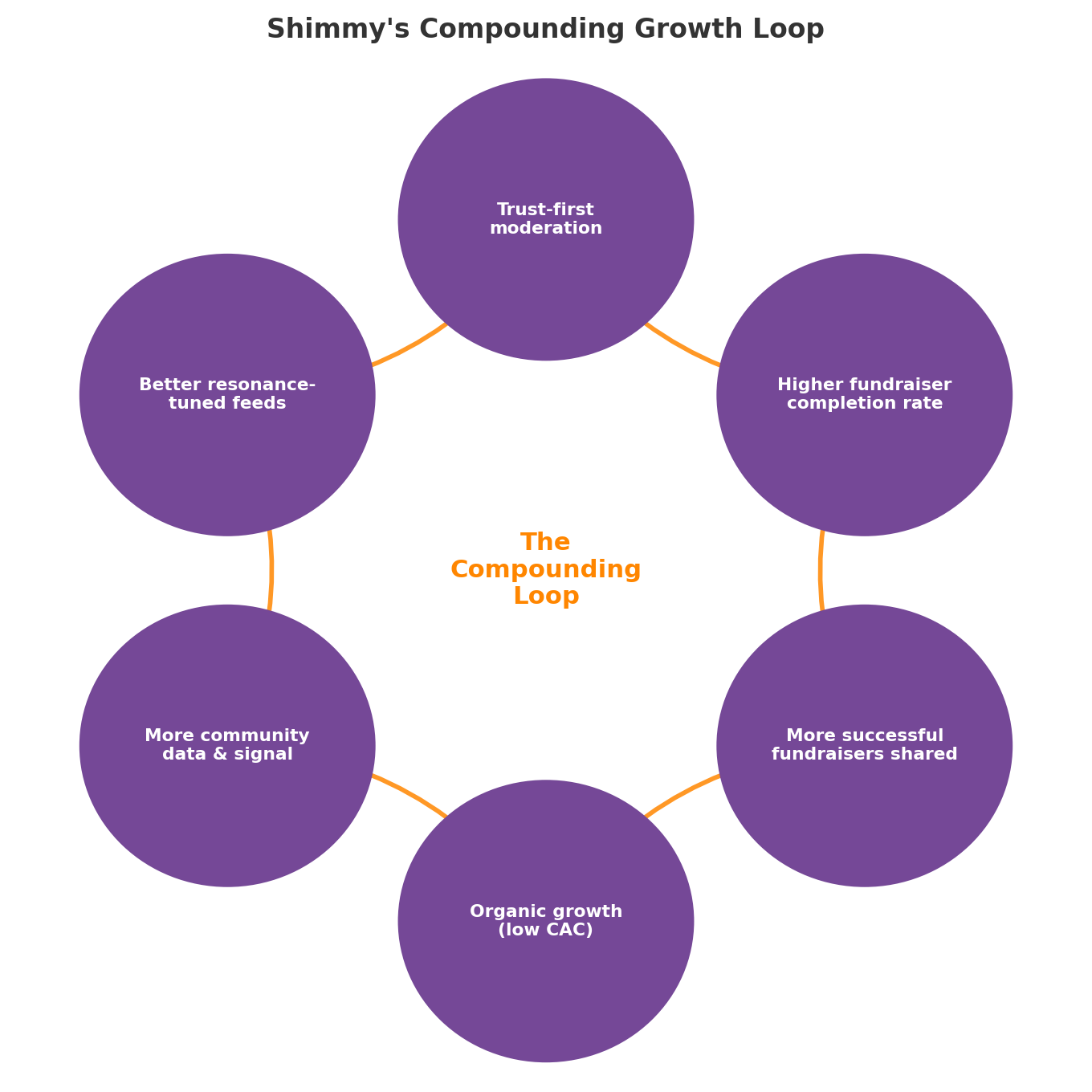
Loop 1 — Trust compounds into completion rate, completion rate compounds into organic reach
This is Shimmy's most differentiated loop, because it's structurally unavailable to engagement-first incumbents. Per Pillar I, Part 2.3, the provenance/trust infrastructure built for moderation directly increases donor confidence and thus fundraiser completion rates. A completed, successful fundraiser gets shared by the people it helped — genuinely, not incentivised — which is lower-CAC distribution than any paid channel. The loop only works if trust infrastructure (Shimmy Shield) keeps pace with growth, which is why Risk R-4 and R-5 (audit-log scaling, synthetic-spam resistance) are existential to this specific growth mechanism, not just technical hygiene.
Loop 2 — Resonance data compounds into better feeds, better feeds compound into retention
Per Pillar II, Part 4, Shimmy tracks resonance metrics (time-well-spent ratio, completed-intent rate, regret rate) alongside standard engagement metrics from V1 onward. The compounding mechanism: more usage generates more resonance signal, which tunes the Ranking Logic layer of the Shimmies architecture (Pillar II, Part 1.1) more precisely per community, which increases the odds any given session leaves someone better off, which increases retention and referral. This is the same data-flywheel mechanic that powers engagement-first platforms — Shimmy's bet is that optimising it against resonance rather than raw engagement produces a different, defensible feed quality rather than a worse one.
Loop 3 — Shared feed configurations compound into low-CAC distribution
Per Pillar II, Part 1.4, because Shimmy compositions are portable, storable objects, a user who builds a genuinely good feed can share it as a link/template others adopt. This is architecturally cheap once the Source Selector / Ranking Logic / Presentation Shell decoupling is built correctly, and it is a growth mechanic native to the product thesis rather than a bolted-on referral programme — it only exists because of a specific architecture decision, which is why Pillar II flags that decision as the single highest-leverage near-term engineering choice.
Loop 4 — Invite-only scarcity compounds into perceived value and curated quality
Shimmy launches invite-only. This is a deliberate growth-and-quality lever, not just an access-control decision, and it compounds through two separate, well-evidenced mechanisms:
- Scarcity increases perceived value. Invitation-gated access is a well-documented driver of early adoption intensity — Gmail's multi-year invite-only period and Clubhouse's invite-only launch both converted scarcity into outsized word-of-mouth demand, precisely because an invitation signals both exclusivity and personal endorsement from the person extending it. Each invite sent is therefore a small, high-trust act of social proof — closer to Loop 1's fundraiser-sharing mechanic than to a conventional referral programme.
- Gating access protects the two things Shimmy can't recover once lost: trust density and moderation headroom. An invite-only cohort lets Shimmy Shield's tiered moderation stack (see Shimmy Shield) and the Tier 0 pre-launch team (Pillar IV) scale into demand rather than being overwhelmed by it — directly consistent with the small-team-plus-AI-leverage thesis in Pillar III: Operations. A slower, invite-gated ramp is a genuine trust-and-safety control, not only a growth tactic.
The strategic risk to manage explicitly: invite scarcity is a growth accelerant only while it's genuinely scarce. Recommend the invite mechanism have an explicit, planned expansion trigger (tied to moderation-capacity headroom and Shimmy Shield's Tier 0/1 readiness, not an arbitrary date) so the transition from invite-only to open access is a deliberate Roadmap decision — see Roadmap & Milestones — rather than something that quietly erodes the exclusivity value before Shimmy is ready to defend open access with mature moderation infrastructure.
The user psychology this depends on
None of the above works unless the underlying behavioural bet is correct. Four psychological mechanisms are worth being explicit about, because they are testable, not just asserted:
1. Habituation and hedonic adaptation cut both ways
Engagement-maximising feeds rely on variable-ratio reinforcement (unpredictable rewards, the same mechanism behind slot-machine design) to sustain compulsive use even as satisfaction declines — this is well-established in behavioural psychology and is a large part of why time-on-platform and reported wellbeing have diverged industry-wide (see the doomscrolling data below). The same habituation mechanism can work in Shimmy's favour: if early sessions reliably leave a measurable positive residue (per the resonance metrics), that becomes the variable a user's habit forms around instead of pure novelty-seeking — a stickier, less extractive habit loop, but a habit loop nonetheless. This is a real psychological bet, not a purely feel-good one, and should be tracked with the same rigour as any other retention driver.
2. Social proof compounds fastest around identity-relevant causes
Donation behaviour is unusually sensitive to social proof from people the donor already trusts (per the donation-based crowdfunding data, campaigns with visible community backing convert meaningfully better than cold outreach). This is why Loop 1 above is structurally different from generic virality — a shared fundraiser isn't asking someone to try a new app, it's activating an existing trust relationship for a specific, legible cause, which has a much higher conversion ceiling than feature-based virality.
3. Fatigue is not the same as disengagement — it's latent demand
The data in Market Appendix, Section B is worth reading psychologically, not just statistically: 46% of UK adults actively avoiding news because of its emotional cost, and 91% of young UK women reporting negative mental-health impact from social media, are not people who have stopped wanting connection or information — they are people paying an emotional tax to get it from the only available channels. That gap between demand for the underlying need and tolerance for the current delivery mechanism is the actual market opportunity, and it should be monitored over time (see the tracking note below) rather than assumed permanent.
4. Calibrated friction increases trust rather than reducing engagement
A counterintuitive but evidence-supported point: interfaces that introduce small, legible friction at moments of potential regret (a pause before a large donation, a gentle prompt before an angry reply) tend to increase long-run trust and satisfaction even though they reduce short-run action rate. This is the psychological justification for Pillar II's stance on streaks and notification design — deliberately not manufacturing anxiety-driven return visits — and it should be treated as a genuine design principle to defend under growth pressure, not a nice-to-have that gets cut when a growth target is missed.
5. Scarcity and in-group belonging drive early intensity, but only if the "in-group" earns it
Invite-only access (Loop 4, above) works psychologically because scarcity and social endorsement are among the most robust findings in behavioural psychology — but the effect is conditional, not automatic. Scarcity that isn't backed by genuine differentiated value curdles into resentment once the novelty wears off (a well-documented failure mode of hype-driven invite-only launches that didn't have a real product underneath the exclusivity). Shimmy's position is stronger than a pure-hype invite mechanic because the exclusivity is doing real work — protecting moderation quality and trust density, per Loop 4 — which means the early cohort's experience should be measurably better, not just exclusively branded. This is testable against the resonance metrics in Pillar II, Part 4 and should be tracked as a specific hypothesis: does the invite-only cohort show higher resonance scores than a comparable open-access cohort would, or is the exclusivity purely perceptual?
The evidence behind the psychological bet
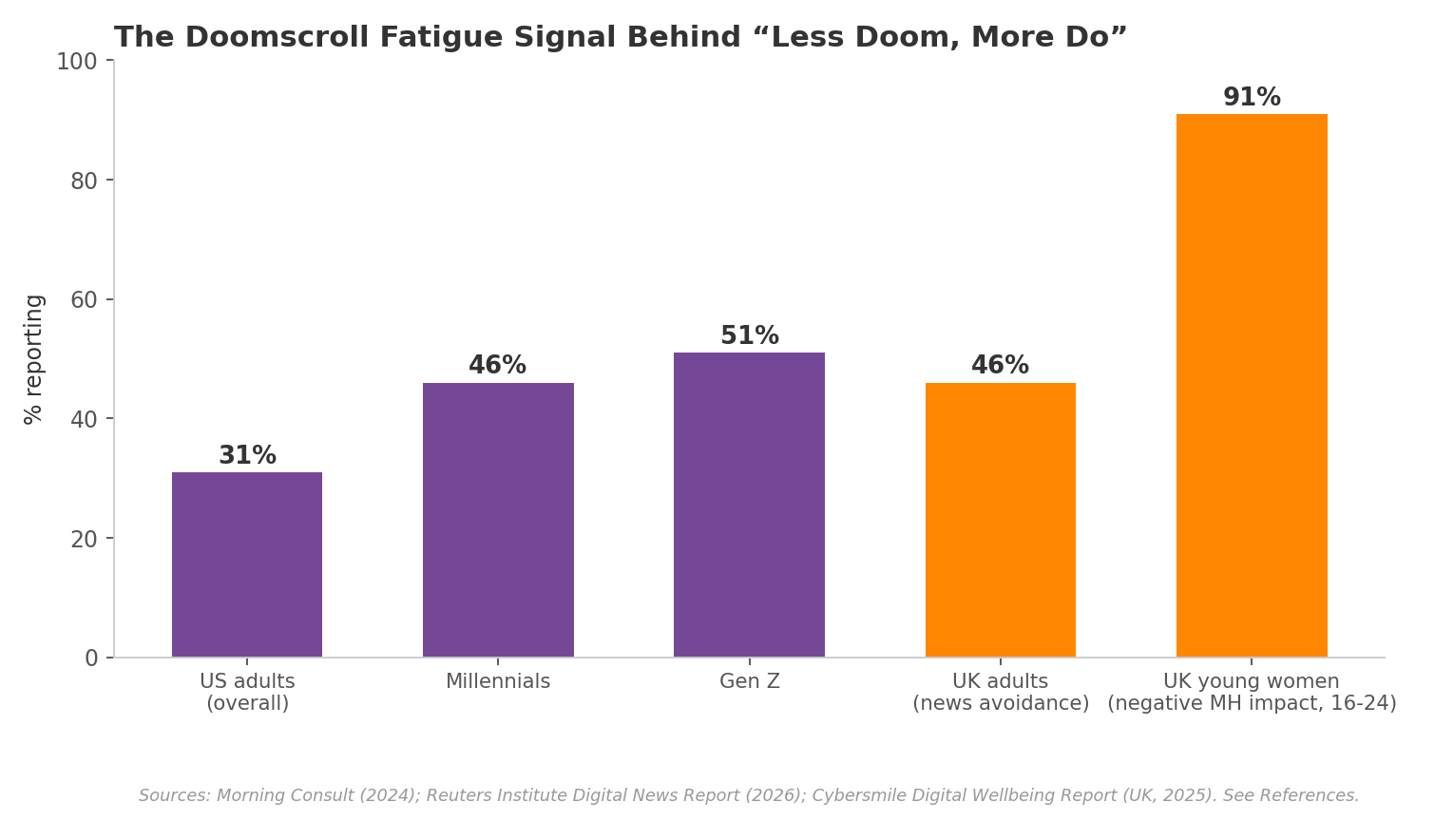
This is the same data underpinning the Executive Summary's "why now" argument, but worth sitting with directly here: the generational gradient (31% → 46% → 51% from general US adults to Millennials to Gen Z) suggests this isn't a fixed trait but a worsening trend concentrated in exactly the cohort most valuable to a new social platform's long-run growth. This should be re-checked at each suite review — per the Market Appendix's own read, if UK news avoidance or doomscrolling prevalence starts declining, that's a signal to revisit whether "anti-doomscroll" remains the strongest lead positioning, rather than a permanent assumption baked into the brand.
What would falsify this thesis
In the interest of the evidence-over-assertion standard applied throughout this suite, it's worth naming what would indicate the compounding-growth bet is wrong, not just citing supporting data:
- Resonance metrics fail to predict retention — if time-well-spent and completed-intent scores don't actually correlate with 30/90-day retention once real data exists, Loop 2 doesn't hold and the product should compete on conventional engagement mechanics instead.
- Fundraiser-driven sharing shows normal, not elevated, conversion — if Loop 1's social-proof advantage doesn't show up in actual referral conversion data once measurable, the trust-first positioning is a cost without a compounding payoff and should be re-priced as pure brand differentiation, not a growth engine.
- Friction reduces trust rather than building it — if calibrated-friction UX patterns simply reduce usage without an offsetting retention/trust benefit, that specific design principle should be revisited rather than defended on faith.
- Invite-only exclusivity shows no resonance uplift — if the invite-gated cohort doesn't measurably outperform on resonance metrics once comparable data exists, the exclusivity is doing perceptual work only, not quality work, and the expansion trigger discussion in Loop 4 should move up rather than wait for a moderation-capacity milestone.
Tracking these three falsification checks is recommended as a standing quarterly review once V1 usage data exists, alongside the Risk Register's review cadence.